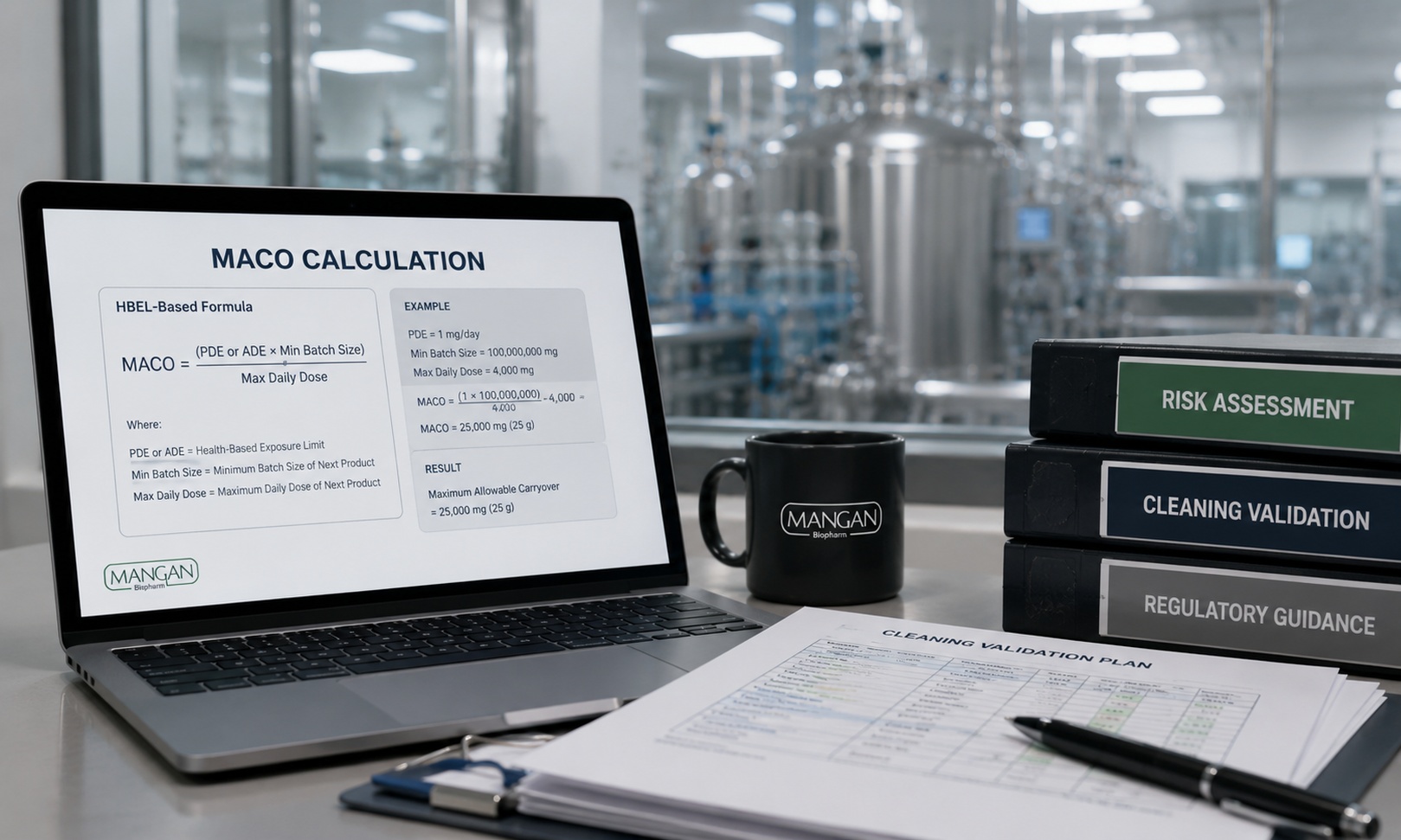
Understanding MACO: Why Maximum Allowable Carryover Matters
In the biopharmaceutical industry, risk-based cleaning is essential for patient safety, product quality, and regulatory compliance. One critical component in this process is the rigorous calculation of Maximum Allowable Carryover (MACO), which defines the maximum amount of residue from a previous product that can be safely carried over into the next product without posing a risk to patients. At Mangan Biopharm, we understand that accurate MACO calculations are the cornerstone of effective cleaning validation. This not only protects patients and product quality but also supports robust compliance with FDA and global health authority expectations.
MACO is a calculated value, rooted in health-based exposure limits, that defines the threshold set to minimize risk. Utilizing the right formulas and reviewing examples boosts confidence during audits, helps defend your process validation strategies, and ensures ongoing inspection readiness. Let’s explore key concepts, step-by-step calculation methods, and industry best practices.
Key Concepts and the Foundation of MACO Calculations
The science behind MACO is built on toxicological data, batch-specific parameters, and a systematic approach. In cleaning validation, our goal is to ascertain the highest amount of residue that can safely be present on shared manufacturing surfaces. Using MACO Calculations allows us to ground cleaning limits in patient safety and product quality and align with regulatory guidance. The three main concepts we focus on are:
- Patient Safety: Using safety-based calculation limits to prevent cross-contamination and protect patients.
- Cleaning Validation: Provides documented evidence that cleaning procedures consistently remove previous product residues, cleaning agents, and microorganisms to safe predetermined levels.
- Regulatory Requirements: Meeting expectations set by agencies such as the FDA and EMA, who expect robust, defensible data for every cleaning validation program.
- Product Quality: Prevents cross–contamination -ensuring the residues from a previous product do not contaminate the next product.
The process typically begins by gathering critical data: permitted daily exposure (PDE) or acceptable daily exposure (ADE) values from toxicological assessments, batch sizes, the maximum daily patient dose, and equipment surface areas. This risk-based approach aligns with guidelines such as ISPE’s Cleaning Validation Guidance, as well as EMA’s HBEL guideline, which defines current regulatory expectations for HBEL-based cleaning limits.
If you want to dive deeper into cleaning requirements, you can explore our Cleaning Validation resource center.
MACO Formulas and Examples: Stepwise Approach
To ensure consistent results and regulatory acceptance, Mangan Biopharm follows a step-by-step process when performing MACO calculations. Here’s how we approach the task:
Core MACO Formulas Explained
There are several accepted formulas for MACO calculation. The two most widely used in the pharmaceutical industry are the Health-Based Exposure Limit (HBEL) method and the Dose Based Approach.
- HBEL-Based (PDE or ADE) MACO Formula:
MACO = (PDE or ADE of Product A mg/day) x (Minimum batch size of Product B mg) / (Maximum daily dose of Product B mg)
- 10 ppm Criteria Formula:
MACO = (10×10-6 ) x (Minimum batch size of Product B mg)
- Therapeutic MACO Formula
Minimum Therapeutic Dose (mg) x Minimum Batch Size of the next product (mg) / SFt (Therapeutic Safety Factor) X Maximum Daily Dose of the next product
- Toxicological MACO Formula = ADIxMBS / SFt x MDD
Key Parameters for Calculating MACO
- ADI: Acceptable daily intake, (mg);
- HBEL: health-based exposure limit value of the previous product (mg/day);
- MBS: minimum batch size of the next product (mg);
- MDD: maximum daily dose of the next product (mg);
- MTD: minimum therapeutic dose of the previous product (mg);
- SFt: therapeutic safety factor. SFt was set at 1,000; being in the denominator, it makes the result more stringent. The program converts all values to milligrams for ease of data manipulation
We select the most stringent value from multiple methods as the cleaning limit. This builds a robust validation strategy and satisfies auditors looking for a science-based approach.
Step-by-Step MACO Calculation Example
Let’s review an example using the HBEL method. Suppose Product A’s PDE is 1 mg/day, and Product B (the next product manufactured) has a maximum daily dose of 4 g (4000 mg). The minimum batch size of Product B is 100 kg (100,000,000 mg).
- MACO = (1 mg/day x 100,000,000 mg) / 4000 mg
- MACO = 100,000,000 / 4000
- MACO = 25,000 mg (or 25 g)
This result indicates that 25 g of Product A residue would represent the maximum allowable carryover into the next batch of Product B. We then relate this value to the equipment surface area to establish limits for swab or rinse testing during Cleaning validation.
Additional Example: 10 ppm Method
Suppose Product B’s minimum batch size is 100 kg. The 10 ppm MACO would be:
- MACO = 10×10-6 x 100,000,000 mg = 1000 mg (1 g)
The lower value from the previous PDE-based calculation (25 g) would be used as the cleaning limit for this product-change scenario.
If you need assistance in applying or defending MACO Calculations we recommend reviewing our cleaning validation services.
Avoiding Errors and Ensuring Accurate Calculations
Rigorous cleaning validation programs rely on accuracy. Common errors in MACO calculations often relate to faulty assumptions, missing data, or transcription mistakes. Here are key pitfalls Mangan Biopharm works to avoid:
- Overlooking batch size or dose discrepancies between products
- Using average instead of minimum or maximum batch sizes
- Failing to update toxicological data for newly introduced products
- Rounding values too early in the calculation sequence
- Missing conversion between units (mg/g/kg, etc.)
To ensure precise, reproducible results, we regularly audit our calculations, peer-review data sources, and leverage validated spreadsheet tools. Transparency in each assumption or parameter builds a defensible position for regulatory inspections. Our team documents every step, cross-references calculations in protocols, and establishes clear acceptance criteria. Monitoring system changes, such as introduction of new products or altered batch sizes, also helps sustain the integrity of cleaning limits throughout product lifecycle.
This dedication aligns with the best practices described by regulatory agencies. For more regulatory reference materials, consult our regulatory guidance links portal for real-time updates.
Summary of MACO Calculation Methods
Proper implementation of MACO enables us to set science-driven cleaning limits, uphold patient safety, protect product quality, and withstand the rigors of regulatory audits. The strength of our approach lies in:
- Deploying multiple formulas and selecting the most conservative result
- Validating toxicological assumptions for each product transfer scenario
- Periodic review and update of calculation parameters
- Transparent documentation and peer review
- Clear accountability across technology and compliance teams
For those seeking deeper reference material, established resources such as the ISPE Cleaning Validation Guidance offer foundational industry best practices.
In the end, MACO Formulas aren’t just about the numbers – they reflect our commitment to quality, safety, and continuous improvement. If you would like Mangan Biopharm to review your cleaning validation strategy, reach out to our experts today. Your next audit-ready solution is just a conversation away.
FAQ
What is MACO and why is it crucial in pharmaceutical manufacturing?
MACO stands for Maximum Allowable Carryover. At Mangan Biopharm, we emphasize its importance because it ensures that residues from one product do not contaminate subsequent batches. This is vital for patient safety, regulatory compliance, and maintaining high product quality across manufacturing processes.
How do we approach MACO calculations?
Our process for MACO calculations includes a step-by-step guide using clear formulas. By breaking down each calculation, we make it easier for teams to understand and apply these methods confidently. Moreover, we consistently update our training materials for clarity and accuracy.
What are the key concepts we consider in MACO calculations?
When carrying out MACO calculations, we focus on safe residue limits, cleaning validation, and cross-contamination risks. We also factor in product potency, batch size, and safety factors. These elements help us ensure that our cleaning processes meet regulatory standards while delivering quality results.
What are some common mistakes to avoid in MACO calculations?
Many teams overlook unit consistency or miss critical safety factors during calculations. In addition, some forget to recalculate using updated batch information. To prevent errors, our procedures include regular reviews and cross-checks, ensuring precision throughout each project.
Can you share tips for accurate MACO calculations?
For reliable results, always double-check batch data, use current formulas, and document each step of your calculations. Furthermore, reviewing calculations with a peer can catch potential oversights. By following our best practices, you can achieve consistent and compliant MACO calculation outcomes.